

A recent decision out of the Southern District of New York provides a textbook analysis of how courts evaluate advertising claims under New York General Business Law (“GBL”) §§ 349 and 350 (which prohibit consumer deception and false advertising), and underscores the litigation risk that comes with certain health or performance claims. In Noriega v. Abbott Laboratories, Case No. 1:23-cv-04014-PAE (Dkt. No. 132) (S.D.N.Y. June 4, 2026), the court denied defendant Abbott Laboratories’ (“Abbott”) motion for summary judgment on deceptive advertising claims targeting Abbott’s marketing of its product PediaSure as “Clinically Proven to Help Kids Grow.”
The Case
The plaintiff (representing a putative class) is a Bronx grandmother who stated that she purchased hundreds of bottles of PediaSure (a nutrition shake) for her grandson. For some years the product had been marketed with the statement “Clinically Proven to Help Kids Grow,” along with an accompanying footnote to a disclaimer (the specific text of which has changed over the years). Along with the statement and disclaimer, the label has included a cartoon giraffe wearing sunglasses along with tick marks that resemble a ruler.
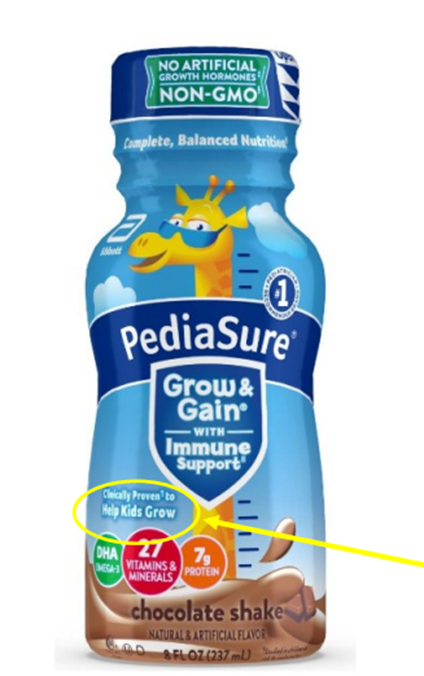
Plaintiff alleged that Abbott misled consumers by marketing PediaSure with the claim that it is “Clinically Proven to Help Kids Grow,” which she argued implied it would help children grow taller, and that that claim allows Abbott to charge a price premium for the product.
In its motion denying Abbott’s motion for summary judgment, the court held that a reasonable jury could find Abbott’s claim misleading based on:
Packaging context (e.g., giraffe imagery and ruler-like graphics suggesting height);
Advertising narratives focused on shorter children and parental concern about growth; and
The ambiguity of the word “grow," which could be read as referring to height.
Critically, the court found that disputes over whether the claim was substantiated and materially misleading were questions for a jury, and not suitable for resolution on summary judgment.
Three Takeaways for Advertisers from the Court
Takeaway One. Courts consider the context. Even if a claim is not literally false, courts will evaluate it in context, including imagery, branding, and surrounding messaging. Abbott’s statement “helps kids grow” may not have been inherently or specifically limited to height. But, the court determined that giraffe + height markers + “growth concern” commercials created a plausible interpretation tied to height growth.
Takeaway Two. Courts may view certain phrases as higher risk. The phrase “clinically proven” was central to this case. One of the plaintiff’s experts argued (and the court credited) that a reasonable juror could determine that the studies cited by Abbott (a) may not have supported height growth at all, and (b) were conducted on populations (e.g., malnourished children abroad) that may not generalize to the target consumer base.
Takeaway Three. Disclaimers are not bullet proof for a court. Abbott relied heavily on a footnote disclaimer on the product packaging indicating that studies were conducted on children “at risk for malnutrition” (among other statements). But, the court held that a jury could find that disclaimer ineffective, in part because it was small and so detached from the primary claim.
Bottom Line.
This recent decision from the court is a reminder that courts view advertising holistically under GBL §§ 349 and 350.
/Passle/69ce4c141e42eea3bd4c2856/SearchServiceImages/2026-09-10-19-25-14-418-6aa3041aa309dcf7376bc3b9.jpg)
/Passle/69ce4c141e42eea3bd4c2856/SearchServiceImages/2026-09-10-17-17-42-908-6aa2e6364c210030134b8622.jpg)
/Passle/69ce4c141e42eea3bd4c2856/SearchServiceImages/2026-07-15-18-48-06-518-6a57d5e6200f7fa481c657de.jpg)
/Passle/69ce4c141e42eea3bd4c2856/SearchServiceImages/2026-07-07-01-34-36-951-6a4c57acfc4b15f7af797164.jpg)


